Gippsland Climate News

Bushfires Silent Vigil in Bairnsdale Mall


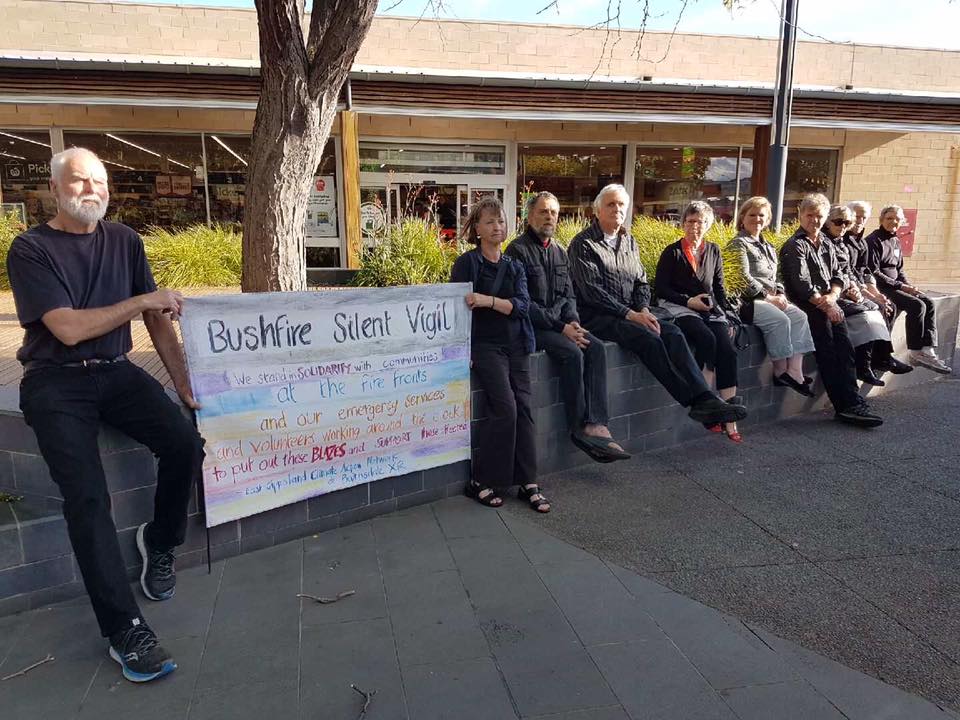
The notice for this climate action was short. An email from East Gippsland Climate Action Network (EGCAN) and the local Extinction Rebellion (XR) group* received late Thursday gave notice of a silent vigil to be held for half an hour in the Nicholson St mall. The purpose it stated was as follows: “This will be a respectful symbolic action of support for all the communities facing the incredibly devastating fires in NSW, Queensland and WA. We will stand in solidarity with the bushfire victims, emergency services workers and volunteers.” Participants were invited to ‘wear black for mourning if possible’ and to ‘bring a friend’.

I was five minutes late attending and not dressed for mourning. The vision as I rounded the corner from the Safeway carpark into the mall was quite impressive – a row of silent figures dressed in black – like crows on a fence. I joined the dozen or so participants followed by a few others to bring the total to 17 or 18.

The EGCAN facebook page later reported: “A silent vigil was held in Nicholson Mall yesterday in support of people across Australia affected by bushfires. Members of East Gippsland Climate Action Network and Bairnsdale Extinction Rebellion took part in the vigil. Our Federal Government cannot simply observe these events – this unprecedented destruction of people and homes and land – and keep denying the truth of the Climate Emergency. We stand in solidarity with Australians and communities on the frontlines of the Climate Emergency and our emergency services workers and volunteers working round the clock to put out these blazes and support those affected.”

The response from the public was varied. Some stopped and stared, some avoided us completely, and two delightful souls read the sign, clapped and gave us encouragement. By the end of the thirty minutes (or in my case 25) we finished for which I was thankful as sitting rigidly was causing me some discomfort in the lower spine. There can be little doubt that EGCAN (and XR) are making a splash around Bairnsdale and at the very least causing many to stop and think. Meanwhile the bushfires continue in NSW and Queensland and another hot spell will arrive on the east coast by mid-week (20th).

What is shaping up to be a long, hot summer in a dry Gippsland is still to come. The bushfires in Victoria this century have been frequent, large and damaging to life and property. Recently the fire season in Gippsland extended (in August 2018) to winter fires .  A massive injection of funds and human resources for the State firefighting and emergency sectors is urgently required. On the net the Anthropocene has already been superceded by the Pyrocene. Welcome to the climate emergency.

*there is some overlap between the 2 groups

Climate Change Deniers, Stephen Hawking and Quantum Physics

Nothing annoys me more than the persistent denial of climate science by some whilst they freely use the means of communication that science has given us to promote their propaganda. One wonders if these people ever consider the contradictions this involves. Most of modern western society is based on science including medicine. Without the medical advances of the last 200 years many of our lives would have been short and brutal. (see here)

Recently whilst reading a biography Stephen Hawking: a life of science by Michael White and John Gribbin (BCA/Penguin 1992) I was struck by an early passage in the ‘Classical Cosmology’ chapter explaining quantum physics. In particular I noted how important the science of quantum physics was to things in everyday modern life we take for granted. Most of this White and Gribbin stated “we can safely leave the physicists to worry about” but noted that “it is worth realizing that the physics behind how a computer or TV works depends on an understanding of the quantum behaviour of electrons. Laser beams, also, can be understood only in terms of quantum physics, and every compact disk player uses a laser beam to scan the disk and ‘read’ the music. So quantum physics actually does impinge on our everyday lives…” (p.38)

Thus we have a bizarre situation where computers are the main avenue of communication on which climate deniers either deny or dispute the science of climate change but without quantum physics the computer could not exist. There is a certain irony here and it is a clear illustration of how you cannot choose the science. One wonders where would the climate deniers on the social media be without their computers and smartphones? Making the time and effort to pen a ‘letter to the editor’ of the ‘Daily Blurb’? Perhaps.

Sometime ago I blogged on some facetious comments Hawking had made about climate change deniers . Commenting on the runaway global warming that has occurred on planet Venus he said “‘This is what happens when greenhouse gases are out of control’… implying that our own planet could also meet the same fiery fate. He then amusingly quipped, ‘Next time you meet a climate-change denier, tell them to take a trip to Venus; I will pay the fare.’”

Hawking is no longer with us (he died last year) but his work, and the absurdity of being able to select the science you like and denying or even opposing some aspect you don’t like, remains. The lessons are there in history from King Canute to Stephen Hawking. The climate deniers just have to open their eyes or as Greta Thunberg says “listen to the scientists”. But we won’t hold our breath waiting.

Farmers are part of the Climate Solution by Alan Broughton

Soils provide the greatest carbon sinks apart from the oceans. There is more carbon stored in soil than in the atmosphere and vegetation combined. Despite the massive losses that unsustainable agricultural practices have caused, this is still the case. Sequestering carbon in soils can be achieved much more rapidly than tree planting, and many farmers are now doing that.

Grasses are the fastest carbon sequesters, not in their foliage or roots, though that also contributes, but because of the carbohydrates their roots exude into the soil. Grasses do this to support the microbes in their root zone which in turn mobilise nutrients for the plant. The greatest value are the mycorrhizal fungi that enter the plant roots. Their mycelium networks effectively enlarge the plants nutrient and water searching ability many fold. The by-product is glomalin, a very stable humus-forming compound. Mycorrhizal fungi are very sensitive to nitrate and phosphate fertilisers, herbicides and fungicides. Plant root exudates are reduced when soluble fertilisers are applied.

Grasses need grazers – they have evolved symbiotically. Without grazers the grasslands decline as they get old, photosynthesis ceases, glomalin is no longer produced and woodlands or deserts take over. Woodlands store carbon in their trunks and branches and roots but release little into the soil compared to grasses.

For grasslands to work properly the grazers have to be managed to prevent over-use. In natural herds the animals do this themselves, but when confined by fences they cannot migrate to allow pasture recovery. Farmers can do this, and many now are.

The movement towards regenerative agriculture without chemicals has gained great momentum in Australia and other parts of the world. Many Landcare groups are now providing support. Large numbers of farmers are attending talks and workshops by regenerative farming advocates. There are many fine examples. There is no inherent reason why food production should be a polluting industry. It is polluting because of the huge profits available to input suppliers who are supported by government policies. Change is occurring despite governments and despite the hardships many farmers face. Farmers are the primary victims of climate change; many are realising that increasing soil carbon is the best way of creating resilience. Soil carbon stores vast amounts of water.

The debate about agriculture’s contribution to greenhouse gases has been perverted. Methane is not the important issue – nitrate fertilisers and soil carbon loss are the important issues. Alternative agriculture in its many forms and terms – organic, biological, biodynamic, ecological, agroecological, holistic – provides the solution. Corporate influence on governments, farmer information services and agricultural education and research is the major barrier to change agriculture from a greenhouse gas producer to a greenhouse gas sequester.

*Alan is a Gippsland teacher and author of Sustainable Agriculture Versus Corporate Greed.  Previously published by Green Left Weekly 

Agriculture’s Greenhouse Gases by Alan Broughton

All three major greenhouse gases are influenced by farming practices: methane, nitrogen compounds and carbon dioxide.

Methane: the contribution of farming to greenhouse gases has centred on methane produced by ruminant animals. This is not where the focus should be. It provides a helpful diversion from the main methane increasing culprit, which is gas mining and use. Ruminants do belch out methane and have been doing so for many millions of years. Nature does not allow waste. In natural systems the methane is consumed by methanotrophic bacteria that live in the soil. In healthy farm ecosystems they continue to play this role, but being very sensitive to synthetic fertilisers and many pesticides they fare poorly in farming systems that rely on chemical inputs.

Ruminants in confined feedlots often produce less methane than grazers, because of their more concentrated lower fibre diet. However, methanotrophs are not active on bare concrete, and the manure is not rapidly decomposed as in a well-managed grassland, so methane and ammonia enter the atmosphere. Feedlots should be phased out, not only because of their net greenhouse gas production but also because the animals are forced to live in non-natural crowded confinement and on non-natural feedstuffs and antibiotics, and the meat produced is nutritionally inferior. Animals need to be removed from feedlots and reintroduced into cropping systems to recycle nutrients and replace herbicides. Rice fields also produce methane. Much of the world’s rice production occurs on what were once natural swamps. In those natural ecosystems, which also produced methane from the anaerobic decomposition of organic matter under water, different kinds of methanotrophs took care of that methane. Synthetic fertilisers and pesticides inhibit their work in rice fields.

Nitrous oxide: the greatest producer of nitrous oxide and nitrogen dioxide is nitrate fertilisers – urea, ammonium sulphate, potassium nitrate, mono- and di-ammonium phosphate and anhydrous ammonia (ammonia gas drilled into the soil). Only a small proportion of applied nitrate fertiliser is used by plants, usually no more than 20%. The rest pollutes the atmosphere as nitrous oxide and nitrogen dioxide, or waterways and aquifers as nitrates and nitrites. The nitrogen compounds are major greenhouse gases, damaging the ozone that helps protect the earth from the sun’s heat. Some of this nitrogen forms ammonia in the atmosphere, combining with moisture to produce acid rain. Nitrate fertiliser use has skyrocketed since the 1950s around the world, from about 5 million tonnes per year to close to 200 million.

In natural ecosystems the nitrogen needed by plants is made available by soil microbes. Farming systems can make use of these microbes as has done for the past 10,000 or so years, unless poisoned by farm chemicals. The greater the damage done to soil microbes, the greater the amount of nitrate needed to get the same yield. Undecomposed manure also emits ammonia and nitrous oxide into the atmosphere. Dung beetles, earthworms and the huge variety of soil microbes deal with manure in a short time, providing conditions are right for their activity, which means no chemical inputs to interfere with their work.

Carbon dioxide: nitrate production is an energy intensive industrial process needing huge amounts of natural gas (methane) to heat nitrogen and hydrogen under pressure to 1,000 degrees to make ammonia which is further processed into nitrate fertilisers. An estimated 3% of global carbon dioxide is the result of burning natural gas for this purpose. Nitrate fertilisers gradually destroy soil organic matter, turning it into carbon dioxide. The bacteria that the fertilisers stimulate need a carbon source for energy – they take it out of the soil. Excessive soil tillage does the same thing. Bare soil also loses organic matter as it becomes oxidised to carbon dioxide. Carbon dioxide (and nitrous oxide and methane) is also produced from burning the fuel to drive the machinery. Efforts should be put into developing energy sources that are renewable.

*Alan is a Gippsland teacher and author of Sustainable Agriculture Versus Corporate Greed. Previously published by Green Left Weekly.

Climate Change and Vaccinations by Mark Kilpatrick

What does climate change have to do with vaccinations? On one level, nothing. But if we look at denial of the science, there are many similarities. Our understanding of the world is based on centuries of scientific inquiry, hypotheses, experimentation, refutation and discussion before agreement is reached as to the validity of the theory explaining how things work. Vaccinations came about through a gradual understanding of germs and how the body defends itself against disease.

The last 80 years has seen an unprecedented decline in mortality due to infectious diseases, due to the development of antibiotics and vaccines. The proof of the effectiveness is undeniable; who today knows anyone who has contracted polio, diphtheria or tetanus? Yet there is an increasing cohort of the population who believe that vaccinations are harmful, unnecessary and part of a conspiracy by “big pharma” and the medical establishment. Apparently, governments and agencies like the World Health Organisation turn a blind eye to the supposed harm vaccines cause because they are beholden to multi-national drug companies. Anti-vaxxers deny the science of immunology based on pseudo-science they read on the internet and their own prejudices, not on any understanding of how the immune system works or of medical science in general.

Similarly, with climate change, the people who choose not to believe the science are doing so because it does not fit their world view. The role of CO2 in creating the greenhouse effect was first postulated in the 1820s by Fourier, since then scientists have been doing what scientists do: they try to pick holes in the argument, conduct experiments, look at alternative explanations for the findings, record temperatures and atmospheric CO2 levels, publish papers which lead to more discussion and arguments back and forth until they come to a consensus. For the last 60 years or so, that consensus has been that the world is warming due to increased C02 from the burning of fossil fuels.

The science is settled. We are today seeing the beginnings of what the science has predicted in terms of a changing climate; coral reef destruction, vast swathes of mangrove die-off along Australia’s top end, drought, bushfires, sea-level rise. Yet still, people refuse to believe the science. Denialists, like anti-vaxxers, do not understand the science or the scientific method that underpins these discoveries. They believe that there is some vast, worldwide conspiracy behind climate science.

Anyone who has read about the history of science knows that discoveries that challenge our current view of the world are usually met with disbelief and hostility. Galileo was found guilty of heresy and lived the remainder of his life under house arrest for daring to suggest that the earth travelled around the sun. This was an affront to people who believed that the earth and humanity was the centre of the universe. Charles Darwin was ridiculed for his theory of evolution because people could not accept that we were “descended from apes” rather than being created by God in his image. Scientists have been burned and tortured because their theories disturbed deeply held world views.

We have long believed that we can take what we want from the planet, buy whatever we desire, and throw away what we don’t need. This underpins much of our modern life. No wonder so many people are unable to accept that this is not sustainable. It is easier to deny the science, castigate people like Greta Thunberg and crank up the air-con.

What do we suppose that an anti-vaxxer would do if their child contracted polio and could suddenly no longer move and was struggling to breathe? They would most likely go to the nearest emergency department and put their faith in modern medical science to save their child’s life.

And hope it’s not too late.

*Mark is a community health nurse in East Gippsland

20 years of Bairnsdale Urban Landcare Group by Ann Robson & Maxine Semple

Scouts working with BULG

Bairnsdale Urban Landcare Group Inc (BULG) was formed in 1999 following concerns from residents about the badly degraded state of the Mitchell River and its environs. Native vegetation was poorly managed; exotic weeds had invaded; silver poplars were taking over; there was poor access to the river; a walking track needed upgrading and extension; limited views of the river; and failure to treat the river and its environs as an asset.

Since its formation, BULG has been involved in the redevelopment and construction of walking tracks; the removal of poplars; establishment of the 2 year adopt-a-site program in 2003, where the northern bank was divided into 19 sites and community groups invited to ‘adopt a site’ for two years to plant and maintain the sites. Many local schools, the community college, local businesses, families and Landcare members signed up and subsequent revegetation of both sides of the river saw 12,000 indigenous trees planted.  Over 35,000 seedlings have now been planted across all of our sites. Maintenance and weed control continues; interpretive signage has been installed; 2 flower plots have been established to promote local indigenous flower species and water monitoring is a regular occurrence.

Community engagement has been one of our core activities from our first working bee to clean up rubbish to our 20th birthday celebrations in 2019. Our group works in partnership with various schools, colleges, scout groups and engages with and supports like-minded groups such as Friends of Bats & Habitat Gippsland. National Tree Day on the banks of the river and anything up to 80 cubs, scouts and parents join Landcare members to plant, guard, water and mulch 400 to 500 seedlings in the ever-expanding scout plot on the north bank. We have been working with the scouts for almost 10 years and have assisted scouts with their Landcare badges and the necessary volunteer work needed for the Duke of Edinburgh award.

Federation Training VCAL students started working with BULG in 2016 when they resurrected the old community college site on the north bank. This group also collaborated with us in the Port of Bairnsdale project. Some students initially admitted they chose Landcare as an escape from the classroom but they quickly became involved in the work. Their work was rewarded with a regional Landcare award in 2017. For the past two years the Landcare group has been working regularly with VCAL students from Bairnsdale Secondary College. Again the students have taken ownership of a site along the north bank and are creating a new sign for their patch. This work is part of the VCAL personal development program which provides opportunities for the students to expand their observation skills, practise problem solving and increase their creativity and team building skills. BULG, Bairnsdale Scout group and Bairnsdale Secondary College VCAL students were nominated in the 2019 Victorian Landcare Awards for their revegetation work.

In 2019 BULG began working with Noweyung, an organisation that caters for people with different abilities and that was keen to include some meaningful environmental activities in their curriculum. BULG members meet with Noweyung participants twice a month for Landcare related activities.

The 5.4km Mitchell River Walking Track is now a popular tourist and community destination and attracts thousands of visitors each year. Revegetating this important riparian zone with indigenous plants has assisted with erosion control and enhanced water infiltration; created a wildlife corridor, providing habitat for significant birds and animals and providing an additional refuge for indigenous fauna in a time of climate change (bird species in the area have doubled);  and potentiates carbon sequestration.

Neil Rankine and the XR Rebellion by Catherine Watson

Neil Rankine shortly before his arrest (image Channel 9)

Neil Rankine doesn’t fit the stereotype of a climate change activist, by Channel Nine’s reckoning. He is too old and too respectable. “Sixty-two years old, a former mayor, long-time councillor and for decades a CFA volunteer,” reporter Brett Mcleod noted. “But Neil felt so strongly about this issue that he was prepared to be arrested and for the first time in his life locked up overnight.”

On October 7, Mr Rankine, a former Bass Coast mayor, was charged with three counts of obstructing an emergency worker during an Extinction Rebellion (XR) sit-in near the Flinders Street Station. Holding up a hand-made sign reading “Tell the truth”, he was the first protestor to be arrested during a week of protest action in the CBD.

After refusing to accept bail conditions not to return to the protest, he spent the night in lock up. Channel 9 was there to greet him when he was ejected from the Melbourne Magistrates Court the next day, having been bailed to appear in the Wonthaggi Magistrates Court on November 8. After almost 24 hours in custody, he looked bedraggled. He’d only just managed to get his boots on and was still holding a plastic bag of his belongings and his belt. Despite his evident tiredness, he stayed on message. After all, commercial TV doesn’t usually show much interest in climate change. “We have to stand up,” he told the reporter. “We have to take a stand. I’ve attempted all sorts of other ways to get things happening.”…

As a scientist and reader, Neil first heard of climate change more than three decades ago. At first he thought the dire predictions were a little far-fetched, but the more he read and learned the more he was convinced. Over the past decade he has read and listened to the evidence with a growing sense of dread. “The IPCC are telling us that if we don’t get to zero net emissions in 10 or 12 years we sail past our agreed Paris target of 1.5 degrees and most corals are dead. Next comes 2 degrees where all corals are dead and we’ve lost hope or technology of safely controlling the situation. Ask any farmer in Queensland and NSW, he says. They know about climate change. We might have a bit more breathing space in South Gippsland but in time this region too will be ravaged by drought and bushfire and flooding, just like the rest of Australia.”

The full article is in Bass Coast Post here.

Climate Change and Agriculture Part 2 by Nick Blandford

(soilkee.com.au)

The future for agriculture is bright and there are changes that can be made to the agriculture production models to bring them into line with the goals of drawing down carbon and feeding the global population. The goal of these production systems should be to improve soil health as producing healthy soil can store large amounts of carbon to produce enough healthy food and in turn feed a global population of healthy people.

The development of regenerative agriculture has a number of pioneers who have successfully achieved these goals. This includes Gabe Brown from Browns ranch in North Dakota in the USA, Colin Sies from Gulgong in New South Wales and Alan Savoury from Zimbabwe who have changed the paradigm of how agriculture is practised. The key steps of regenerative agriculture to improve soil health are to use minimal soil disturbance, provide armour (plant cover/mulch), increase plant diversity, have living roots in the soil for as long as possible and use grazing animal impact to cycle carbon and nutrients.

As part of this process we also need to internalise the social and environmental costs alongside the economic costs along our food supply chain so that our produce can be valued more effectively for its true cost. This would give farmers the feedback to change their systems. The project drawdown list of the top one hundred ways to reduce our impact on climate change lists a number of these options for the food system and land use. This includes reducing food waste, moving to a plant rich diet, revegetating tropical forests and developing silvopasture on grazing land in the top 10.

Some examples of where these practices have been undertaken in Victoria on a large scale are Jigsaw farms near Hamilton in Western Victoria. The first carbon neutral grazing operation in Australia through the use of silvopasture as a form of agroforestry. Another example is Niels Olsen from West Gippsland who uses a specialised soil renovator, The SoilKee, and diverse cover crops to increase his soil carbon levels and has been the first to gain carbon credits for soil under grasslands.

Agriculture is at a cross road and due to a lack of policy to internalise the environmental and social costs the food supply chain has not provided the signal to producers to reduce their direct greenhouse gas emissions. However, the practices that will be the most productive into the future will be those that have the greatest ability to draw down atmospheric carbon while producing enough food to feed the global population.

Farmers for Climate Action

FCA is a movement of farmers, agricultural leaders and rural Australians working to ensure that farmers, who are on the frontline of climate change, are part of its solution. They are an advocacy group that aims to influence policy to implement a national strategy on climate change. This has culminated with the tabling of a report calling for a national strategy in Canberra a few weeks ago where a delegation of famers spent the week in Canberra and met with ministers, shadow ministers and members of the cross bench including Helen Haines who is pushing to declare a climate emergency. Other activities that the FCA undertake includes training farmers to undertake climate smart agriculture, mobilising farmers to push for a clean energy transition, advocating rural and regional politicians champion climate action and renewable energy for rural and regional Australia and assisting agricultural leaders to advocate for climate action.

*The author is a farmer near Perry Bridge and a member of the FCA

Climate Change and Agriculture Part 1 by Nick Blandford

Agriculture and the global food and fibre system is the one industry that is most at risk from the challenges of climate change.  To feed and clothe the increasing global population as rising atmospheric greenhouse gases cause extremes in weather patterns such as droughts, floods, cyclones and higher maximum day and night time temperatures is becoming more and more challenging. Agriculture is not exempt from the planet’s natural ecological systems though, and the industrial farming practices that have become commonplace are having a negative impact on the balance of greenhouse gas between the soil, ocean and atmosphere with agricultural emissions direct contribution sitting at 10-12% of global emission. These management practices include land clearing and deforestation, intensive animal agriculture and degradation and desertification of agricultural soils.

Throughout the history of agricultural, the need to increase productivity has led practices such as tillage and heavy grazing releasing stored carbon. This can be very effective in short doses to improve soils; however, the overuse of these practices and the gradual decline of soil carbon has led to reduced bio-diversity, poor water and landscape function, and eventually desertification.

Since World War II the use of synthetic fertiliser and chemicals, larger machinery creating more soil disturbance and larger scale monoculture cropping systems have sped up the reduction of soil carbon and the associated negative impacts. This has been particularly damaging to the soil microbiome where a complex economy works underground to trade mineral nutrients and stored water with sugars from plant roots produced through photosynthesis. These synergistic relationships provide food, air, water and shelter for the micro and macro flora and fauna in the soil and this diversity is vital to maintain healthy soils, retain and purify water and draw down carbon. The use of modern farming techniques disrupts these synergies and creates imbalances in mineral availability, water and carbon storage and the productivity of the soil.

The outcomes are that much of the food we now consume has a much lower nutrient value across many of the essential minerals compared to food from pre-war times. If we continue with these current practices there is a forecast of a 30% increase in agricultural emissions by 2050. As productivity of our soils has stalled more land is needed to produce food to feed the growing global population. Resulting in increased land clearing to meet this demand.

We now have unhealthy soils that are producing unhealthy food that is causing unhealthy people, while our landscapes are failing and the soil is unable to be the carbon sink needed to draw down atmospheric carbon.

The implication is that our agricultural production systems are unsustainable. However, this is not a problem for the farmer alone to fix as the consumer and food supply chain are also responsible. The demand for cheap food has culminated in food being devalued and one third of what is produced being lost or wasted along the supply chain. The other side of this is that due to pressures on production and distribution and with a forecast food calorie requirement of the global population set to increase by 60 % by 2050 this is a real risk of food insecurity in large parts of the globe. The take home message is that our current food system is broken and will not cope in its current form to feed the global population while reducing the nett contribution of greenhouse gasses to zero by 2050.

(to be continued)

*The author is a farmer near Perry Bridge and a member of Farmers for Climate Action

Brief Notes on a Meeting with Tim Bull MP

Climate Strike gathering near Tim’s office (image Shelly Nundra)

Tim Bull is the member for the Gippsland East in the House of Assembly in Victoria. At very short notice I was given the chance to have a meeting with him and his political advisor to discuss climate change. The meeting was amicable with Tim saying that most state parliamentarians accept the science of climate change and that most of them support renewable energy projects, though with some reservations. The big problem with this is that accepting the science should not even be on the agenda – it is the same as accepting fact or reality. And it is the science and its implications that needs to be clearly understood.

When the science is looked at seriously the urgency of the problem becomes paramount thus requiring all our actions to be directed towards mitigation and adaption, in other words accepting and working on the climate emergency. The failure (not only of Mr Bull, but of most of the MPs of the major parties) to grasp the basics of the science becomes obvious when there is contradiction in their statements or a ‘disconnect’ between what they say and what they do. In Mr Bull’s case he failed at the first step by supporting the current logging practices and giving the usual reasons why it should continue.

But under no circumstances will logging continue under the real ‘climate emergency’ as there is substantial evidence that forests must be protected as a carbon store (see here and here). Planning should be under way for a rapid phase out of all logging; land clearing and removing any living trees should become a serious offence. At the same time the responsible government department should be increasing employment drastically in fire protection, emergency services, public health, education etc in the areas most affected by the rapid phase out. In any just transition over full employment must precede the phase out.

Tim stated he is in favour of the Star of the South offshore wind project and I suggested he might be more outspoken in his support and that projects like this need to be fast tracked. I further suggested that it was unlikely that Yallourn would see 2030 and that all Gippsland generators would be closed by 2040. I pointed out that there is a crunch coming in the politics of climate change mentioning the Extinction Rebellion and the recent school climate strike protest attended by about 800 and held in the median strip outside his office. And stated that I was with them.

On the whole I am disappointed with my brief half hour. With 3 people present and normal conversation practice one is left with 10 to 15 minutes to make your point. In retrospect I wish I had emphasized that the climate emergency – his coming ‘crunch’ – overrides party loyalty and the other aspects of the status quo; that his legacy will be trashed by his inaction and his children and grandchildren bound to suffer.