Gippsland Climate News

Baw Baw Sustainability Network (BBSN) Film Night

(first published in Sustain July 17)

The BBSN hosted a screening of Guarding the Galilee on Thursday 27th July. Michael Caton hosted the 30 minute documentary on the background behind the proposal to build the country’s largest thermal coal mine in Queensland and the compelling reasons to stop it:

• It doesn’t make economic sense

• It will add enormously to greenhouse gas pollution

• It threatens productive farmland

• It is being given unfair, free access to huge volumes of water that other users must pay for.

• It threatens the health of the Great Barrier Reef and the 65,000 jobs that rely on it

Adani has a record of environmental and social vandalism. Adani has a complex corporate structure that utilises foreign tax shelters which means it will pay little to no tax in Australia. The justification for the development being that it will provide 10,000 jobs is a lie. The federal LNP is proposing to use $1 billion of tax payer funds to build the required rail link to the coast in a process shrouded in secrecy through the Northern Australia Infrastructure Fund.

After the movie we had a discussion about how we might be more involved in the fight to stop the mine. Think Global Act Local was mentioned as were the lessons learned from the successful onshore gas campaign. Ursula Alquier reminded us of the power of a community taking action on their own terms and setting the agenda.  There is a local Stop Adani group in Melbourne who would benefit from our support- please consider joining them.


My appointment as Secretary Renewable Energy Party (REP)

Just a brief note to outline how my new appointment as secretary and registered officer of the REP may, or will, affect this blog. It is not the purpose here to push a party political position or advocate on behalf of any particular party. The problem of climate change as an existential issue is paramount and the purpose is to offer local news on this and make suggestions as to how we might succeed in overcoming what is almost certainly the greatest problem humanity has ever faced. All, of course, related to Gippsland or by Gippsland authors.

Over the last three years the blog has had a number of guest authors. All locals with one or two exceptions, and these were writing about topics specific to Gippsland. The guest authors have a range of political views including some greens – two of whom, Dan Caffrey and Mal McKelvie have previously stood as green candidates. I make no enquiries about a guest author’s political affiliations and welcome contributors from across the political spectrum with the proviso, of course, that they accept the science on climate change, that it is a serious problem and that they advocate possible solutions.

The REP suffered a near death experience after the last Federal Election when all the candidates, myself included, lost their deposits. The leaders, faced with an election only a month or so after getting the party registered, had most unrealistic expectations of what the party could achieve. On the election eve I offered a precautionary pessimistic, but accurate, analysis of the most likely outcome.  For the rest of 2016 and much of this year there has been a leadership vacuum and the committee and office bearers with two exceptions resigned. So our immediate challenge is to keep the party alive.

I see the REP as advocating a return to bipartisanship on climate and hope, at least in the short term, we devote our energy to helping clear our federal parliaments of the climate troglodytes of the major parties – mainly, but not entirely,  the Libs and the Nats.  The blog, hopefully, will continue in the same vein and offer the opportunity to any Gippslander, whatever their politics, to contribute positively on climate change and its solutions.

Community Energy Info Meeting at Bairnsdale

About fifty people attended the information night on Community Energy in Bairnsdale on 20 July run under the auspices of the East Gippsland Shire Council and the Gippsland Climate Council Network (GCCN).

The meeting covered a wide range of related topics mostly about solar, but also including wind, bioenergy possibilities, community education and energy efficiency. Some of the discussion was quite technical and beyond the understanding of part of the audience. For instance there was some discussion on ‘demand response’ – where consumers, usually large ones, are paid not to consume electricity – that went backwards and forwards between some of the more technically minded members of the audience.

A variety of more or less complimentary aims for community energy projects emerged including energy independence, energy security, financial independence and reducing our greenhouse emissions to help mitigate climate change. The research undertaken on behalf of East Gippsland Shire indicates that over $11 million leaves the Shire in electricity generation payments (which also highlights an opportunity). To this can be added the savings of the Shire which, through the big four banks, is also mostly invested elsewhere.

Ian Southall of the Mirboo North Energy Hub and GCCN replaced the advertised speaker Chris Weir from the Bendigo Sustainability Group who had unfortunately caught the flue. Ian is a good friend who has run the Renewable Energy Demonstration Trailer working in schools and communities across Gippsland for five years. He gave an account of the pitfalls that their continuing community energy plans have faced.

As far as I am aware there are no Community Energy projects producing energy in Gippsland. (The South Gippsland Energy Innovation Co-op may have their community energy project of solar PV running but on which I cannot find any information.)  So the speaker for the Bendigo Sustainability Group, which has a number of them up and running, was missed.

Rob Passey clearly outlined the options available to the community, including having functioning micro-grids for small communities at the edges of mains power (Mallacoota, Omeo, Buchan, Dargo), bulk buys of solar panels, and options for organisation and financing of various projects. He also gave brief accounts of some of the operating projects including Repower Shoalhaven.

It is not a matter of choosing between alternatives but going ahead with the best, fastest and easiest options. This could include a number of different projects running consecutively. My preference is for the Repower Shoalhaven model where projects of up to 100kw of solar are installed behind the meter. What is required is organisation, mainly of financial aspects, in which the shire could play a major role. I for one, would be happy to buy a share or help finance putting enough solar on my favourite shire building, our library.


Prescribed Burns and the Carbon Store

Protecting the bush with low intensity burns has been accepted practice in forest management for many years. The Department of Environment, Land, Water and Planning (DELWP) paper on planned burns, which I hope to examine in detail at a later date, has objectives such as the protection of human life, assets and infrastructure that we can all agree with. But at the heart of the conundrum for DELWP is the protection of industry, a euphemism for logging native forests. On the one hand they are to protect the timber resource for the loggers and the other to preserve biodiversity*, the latter including forest as a ‘carbon store’.  Conventional wisdom and current practice suggests that prescribed burning may reduce the chances of crowning fire. But the experience of Black Saturday and some research suggests otherwise.

I have written previously on the burning question urging that planned burns be used only sparingly for asset protection and also a number of times on the importance on the protection of our forests as a carbon store.

In recent work Dr Luke Collins of Latrobe University noted: “The management of forest ecosystems to maintain and increase carbon storage is a global concern, as carbon sequestration has been identified as an effective strategy to help mitigate the effects of climate change. Prescribed burning for wildfire risk reduction has the potential to increase fire frequency across many forest communities. Changes to fire return intervals resulting from prescribed burning may alter demographic processes and growth of tree species, and consequently carbon storage…”

A major overhaul of the so called “forest industry” based on best science is needed urgently. The science clearly indicates that native forests should be protected as a carbon store and not clear felled, that DELWP’s role should move from timber production to forest protection, especially fire protection. With the latter in mind the current policies of low intensity burns should be completely reassessed. And until then only burns for the protection of life and human assets – not including the logger’s timber allocations – should occur.

*This article is only concerned with protecting forests as a carbon store. There are many other aspects of concern for biodiversity with burning for example see here.


Chris Barfoot* on Pumped Hydro

My name is Chris Barfoot and I am a board member of the Gippsland Climate Change Network (GCNN). I was asked to write a short blog on pumped hydro and its opportunities.

But first I want to congratulate all involved in East Gippsland. In my short time dealing with the region I have been amazed at the level of innovation and passion displayed towards changing the future. If I can play a small part in helping it progress further I will be honoured.

Anyway, pumped hydro. This is a concept going back many years. Put simply when you have excess power you use it to pump water to a higher storage place and then when you need power (no wind or sun) you release the water back to the lower point via a turbine to make energy.

This is the fundamental systems used throughout the existing Snowy scheme, Tasmania and of course the famous Snowy 2.0.

It is becoming more popular as the need to back up renewables with storage is being recognised. Some examples have been built using tanks alongside wind turbines (Chile) and more recently there has been a trend to trying to use seawater and an inland dam where wind turbines are based on the coast.

At present pumped hydro is an economic option that can be considered. However the fundamental fact is that you are changing your energy from electricity to pumping and back to electricity. This means you will lose about 20% of your power in these changes of state. So in the longer term as the pricing drops batteries or capacitors are more likely to be the best option.

But one place where it make a lot of sense is where there are existing dams and structures for example in an old mine site. Here you already have the lower reservoir and the cost of construction can be significantly lowered by reuse of these sites. Such systems have been proposed for some the Latrobe Valley mines. Are there any opportunities out East?

*Chris worked in the power industry for 33 years as a scientist, engineer and project manager. He retired with the close of Hazelwood and welcomes the opportunity to work with the renewable energy sector.


Hazelwood’s Barramundi Blues 

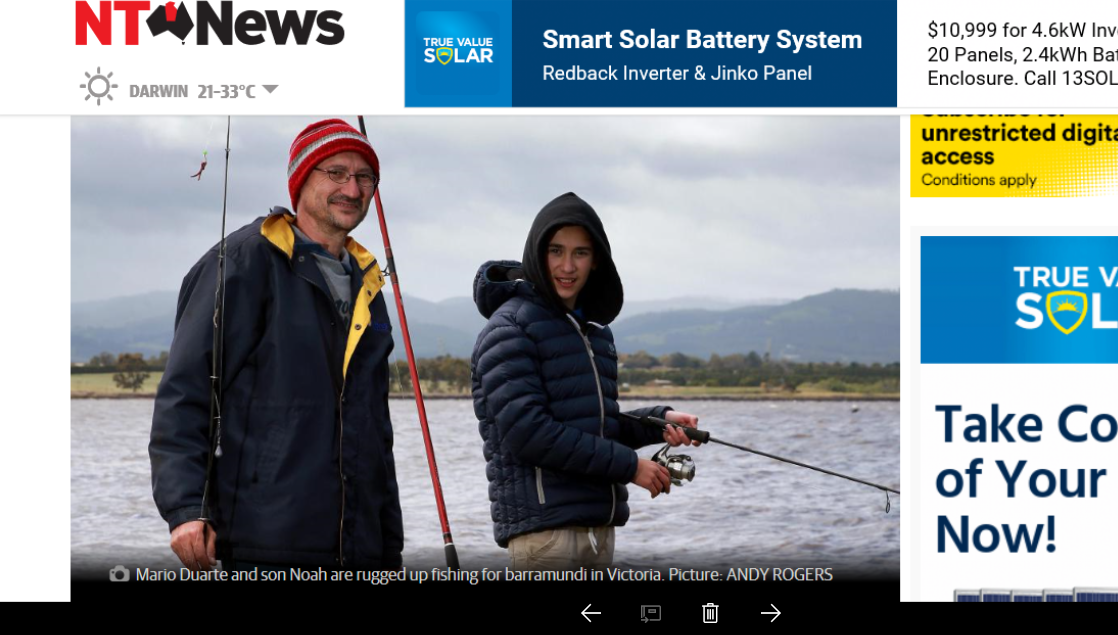
The end of the Hazelwood Pondage Barramundi experiment is nigh. In an article entitled “Territory Barramundi Struggling with Southern Cold in Relocation Project” the Northern Territory News outlined its fate noting “Victoria’s winter is playing havoc with our iconic barramundi in a relocation project that has gone pear-shaped.” Of course as everybody knows it is not the winter that is killing the fish but the fact that the Hazelwood Power Station no longer keeps the waters warm.

The article noted that the “the barra have swum out of the main body of water in the Hazelwood pondage and into a hot water channel in search of the warmer water. The area where they have congregated houses a pipe that continuously delivers warm water from an aquifer underneath the nearby Hazelwood coal mine.”

At the risk of saying I told you so I stated the obvious on 1.1.17 – that the “temperature of the pondage will drop rapidly after the station closes its generators in March which will be the end of this short-lived fishery. Assuming that most of the 5000 fish are caught before the end then each fish has cost us at least $30. This amount of money could have financed an in depth study to utilise the pit and pondage for pumped hydro.” Or, I might add, a small floating solar farm.

I support the fact that State Government is putting substantial (but perhaps not enough) funds into the Latrobe Valley. Such a project if successful in the longer term may have brought many tourists and trippers to Morwell and Churchill. However this clearly showed a lack of foresight – that Hazelwood would probably shut or be closed down in the next few years and that the fish could no longer survive in the colder waters. Therefore it was not money, energy and time well spent.

What is needed for the ‘just transition’ in the valley is more co-ordination, some imagination and above all planning. The underlying assumptions are that all brown coal generation will shut down sooner or later and that renewable energy in its many forms is part of the answer to mitigating climate change. Any state funded projects that clearly do not fit these criteria should not even be considered.


Floating Solar for Gippsland

A recent paper entitled “Proposal for Renewable energy projects in Southern Victoria and Opportunities for Latrobe Valley Development” by Chris Barfoot et al examined the potential for renewable energy to be a major part of a just transition in Gippsland. In particular the paper examined solar, wind, pumped hydro and battery storage opportunities. Here I look at their case for floating solar and hope to examine other aspects of their paper, in particular pumped hydro, at a later date.

The paper lists a substantial number of advantages for floating solar including no preparation for the site is needed; that if associated with established hydro operations there is no need for costly infrastructure upgrades; that when energy efficiencies from the cooling effects of the water are taken into account costs are not that much different from that on land and most important of all the advantages it can be done almost immediately.

Possible sites for consideration included reservoirs and water treatment plants. The Thomson River dam could house a raft of photovoltaics producing 100 megawatts. Listed suitable sites included Lake Narracan, Hazelwood Pondage, Blue Rock Dam and Moondarra. I have noted previously the work of the Mirboo North Community Energy Hub and their current feasibility study where they hope to create a floating solar farm of 1.4Mw in conjunction with Gippsland Water. This was discussed at a recent Gippsland Climate Change Network meeting which also mentioned the suitability of Lake Glenmaggie for floating solar development.

In terms of the ‘just transition’ the paper noted: “Opportunity exists for production of the floats needed through local industries in Morwell under licence from the designer. One style is metal and the other blow moulded plastic. Both industries exist in the Valley. Tracking systems could also be designed and produced using local industry. This would also boost metal supply and fastener industries. Secondly employment opportunities come from the delivery of the float systems to the construction sites. Other works options are the assembly of the rafts, fitment of the panels, wiring and grid connection.”

Above all jobs now, and plenty of them, is the first and most important step in the just transition.

Heyfield, Climate Change and Jobs

The Victorian Government decision to purchase the Heyfield timber mill to save 250 jobs is recent news. The Labour government have been in a bind over this – as well as the closure of Hazelwood and another timber mill (processing plantation timber) in Morwell – for some time. On the one hand they recognise the need to maintain jobs in depressed areas – in particular the Latrobe Valley but also the rural districts in general. On the other hand, unlike their opposition, they certainly give credence to the threat of climate change and give some support to the renewable energy revolution. A similar, and much larger, problem confronts the Queensland Labor government over the Adani coal mine proposals. There they appear to be making all the wrong decisions.

To not do anything about preserving jobs is anathema to a government that supposedly represents workers and to allow mass unemployment to follow the closure of Heyfield and Hazelwood is both to invite political death and to foster political reaction. Lacking any form of imagination, and no doubt with strong union support, the government decided to purchase the mill thus avoiding local reaction and mayhem in the generally antagonistic media.

Then there is a small, but growing, persistent and vocal minority calling for end to the clear felling of native forests. The reasons for this are mainly environmental but it is becoming obvious that if Australia is to meet its Paris Climate obligations, or get anywhere near them, they have both to cut carbon emissions drastically and preserve and protect natural stores of carbon. Our native forests are one of the latter. Hence the bind for the government.

The problem now arises as to what will happen tomorrow. In the short term it will probably be business as usual – continuing to factory harvest a dwindling supply of timber and as a tactical move this purchase may have some attractions for the incumbents. The big decisions come after the next State election. More than ever we need governments planning for a just transition, giving it priority in business and in funding. Hopefully governments are thinking a bit further ahead of the electoral cycle.

The mechanics of a just transition are simple. Before the mills and power stations close governments must recognise this inevitability and provide and stimulate alternative employment in these areas. There should be more jobs available in the areas where they are needed than the projected redundancies. Because these closures must be done as soon as possible now is the time to boost jobs dramatically in these areas. On Coal Seam Gas the State Labor Government has done the right thing but on both coal, and native forests as a carbon store, they are lagging a long way behind.


Notes on Bairnsdale’s Record Frost

The East Gippsland News (5.7.17) featured Bairnsdale’s record cold frost last Sunday. The report seems fairly accurate but it was accompanied by a front page photo of a wall of ice on a Calulu farm. This was misrepresentative as the farmer, due to the very dry June, had left his spray irrigation on overnight making his system an ice making machine.  Invariably what follows these cold snaps is the usual ‘climate change is bullshit’ claptrap. Of course it is not – the frost merely a tiny contribution to even Gippsland climate records where for this one day Bairnsdale was colder than Mt Hotham.

As one who has spent most of his life in the high country winter frosts were, and no doubt still are, the norm. These were common and often severe during dry winters with clear skies for weeks on end. Anecdotal accounts of solar hot water panels (incorrectly called ‘solar panels’ and confused with PVs) freezing to bursting went round Bairnsdale. If correct the owners of these panels had neglected to have cheap protection systems installed on them. These have been available for many years and I had them installed on my solar hot water panels in Ensay (frost country) in1986. Basically a thermostat opens a valve when the temperature gets too cold and drains cold water from the panels and replaces it with hot water from the tank.

Being used to frosty weather the frost in town did not seem so bad and was probably only minus one or two degrees. This is probably because of the ‘heat island effect’ (where the towns store heat in roads, masonry and buildings) and because of the need to eliminate this bias from records the Bairnsdale weather station is at the Airport about 8 kilometres from town.

It may come as a surprise for some that such record colds are still quite compatible with global warming. The CSIRO calculates that the ratio of heat related records to cold that are broken is six to one. In other words we still get the cold events and records but these are far outnumbered by the hotter ones. In a steady climate system (if such a thing could exist) hot and cold record events should be roughly even. I have written about this a number of times before (see here) using a normal or bell shaped curve as representative of our climate. With climate change the curve is moving to the right or the warmer side of the graph and the average days are also doing so, that is getting warmer. Sometimes for the ease of simplicity the shape of the bell curve remains unchanged but in reality the curve is also getting flatter. This means we have less average days but far more warm ones with still the occasional extreme cold.

The Bairnsdale frost was a significant local weather event but nothing major in the scheme of things except perhaps as an indicator that the country is drying off.


Climate Change and the Media

Nothing annoys me more at the moment than the current treatment of climate change by the media. I am not referring to the denialist diatribes that regularly emanate from the Melbourne Peoples Daily or, worse still, the Australian. Theirs is a combination of some of the worst aspects of journalism – propaganda based on ignorance and approaching criminal negligence.

However the liberal media – amenable to the challenges of science – seem to have two major faults in their treatment of global warming. These faults are based on the misconception that climate change is just an environmental problem. Whilst it clearly is an environmental one it is also, more importantly, an existential one. By the latter term I mean that life as we know it, and even human existence itself, is threatened by climate change. It should not be confused with the French philosophy of Sartre and Camus concerned with individual freedom and free will.

The treatment of climate change as an environmental issue only and not an existential one enables the issue to be politically exploited. An issue that almost all the science indicates should be bipartisan and treated with urgency becomes politicised. It becomes a left – right problem with one side (the greens) having some reasonable policies on the issue and the other side in extreme denial that there is a problem at all. This is made more complicated still by the fact that the greens have little traction outside the main cities and their occasional flirting with animal liberation has left them on the nose in the bush. Farmers, who have most to benefit from actions to combat climate change and most to lose with no action, are represented by a party of inaction and denial – the Nationals.

The second problem with compartmentalising the issue is that it does not get anywhere near the prominence or intensive treatment it deserves. The real debate in climate change is not between mainstream science and the deniers but between scientists considering how bad the outcome will be. There are a number of eminent climate scientists (Hansen, Wadhams) expressing alarm at the current state of affairs and that we are heading for worst case outcomes that threaten civilisation and possible human existence itself. The irony of course is that we all will suffer including the children and families of the deniers, and the deniers themselves.

Of the main news sources I peruse online on a daily basis all categorise climate change as an ‘environmental’ issue. Both the Melbourne Age and the Guardian deal with climate change under the ‘environmental header’. Occasionally one of these articles sneaks through to the home/front page. Likewise the Conversation – a continuing source of accurate and up to date information – have their climate change articles under the header ‘Environment and Energy’. On the ABC – again a good source – anything on climate is sometimes hard to find. The most important issue of our times deserves a massive and thorough treatment in all the media – on the front page or as lead news item – again and again and again.